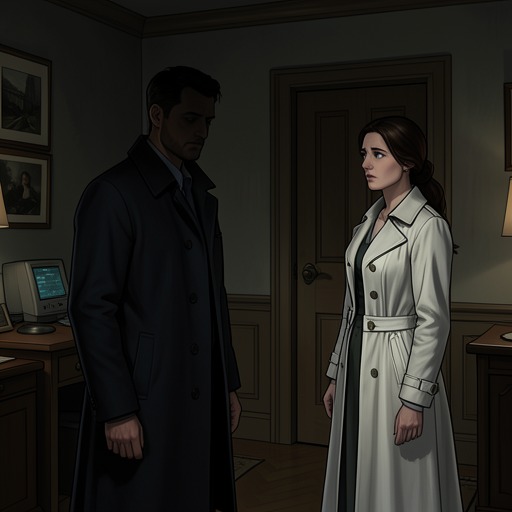
Derek Simmons’s recovery of his memories
The Book of MirrorsDerek Simmons’s recovery of his memories is a turning point in his life after amnesia: an ordinary television report unlocks recollections tied to Anne, Joseph Wieder, and the events that led to his arrest and hospitalization. Yet the episode does more than restore a past. It changes Derek’s understanding of the man who had cared for him, while leaving the reader to distinguish recovered memory from established fact in a story deeply concerned with how recollection can be shaped.
The Trigger and the Return
In the middle of March 1987, Derek was at home changing television channels in search of a film when a news item on NY1 reported that a man from Bergen County had died by suicide. Derek recognized the man as Stan Marini. The recognition carried details beyond the name: Marini had been part of the maintenance crew when Derek worked at Siemens, had married at about the same time as Derek, and had moved to New York City. Derek understood that he was remembering information no one had told him and that he had not read. That distinction made the moment decisive: this was not simply a story supplied by someone else, but a recollection he took to be his own.
The return felt sudden and overwhelming. Derek compared it to a lid lifting from buried material and to watching a film at extreme speed. The image suits the novel’s recurring concern with memory as something that can appear complete and vivid while remaining difficult to verify. For Derek, however, the first consequence was practical: afraid that the memories might disappear again, he found a notebook and began writing down whatever came into his mind rather than waiting to contact Wieder.
What Derek Remembered
The material that surfaced joined personal history to the sequence of events surrounding Derek’s loss of memory. He recalled meeting Anne and their marriage being good at first, then his belief that she had begun cheating on him. He remembered concluding that she was involved with the college professor, Wieder, and feeling that she had made a fool of him. These are Derek’s recollections and interpretation of the relationship, not independent confirmation that an affair occurred.
His memories also reached the morning conversation with Wieder, his arrest, and the difficult period in the hospital. This reconstruction connected experiences that had previously been inaccessible to him as part of his identity. Derek had retained practical abilities during his amnesia: he could repair things, for example, without remembering when or how he had learned. The return of personal memories therefore did not amount to learning an entirely new past; it brought identity-linked events back into relation with skills and a life that had continued in their absence.
From Benefactor to Suspected Keeper
Before this recovery, Derek regarded Wieder as the person who had made his life after hospitalization possible. Wieder had served on the panel that approved his release, found him a place to stay near his own house, and given him paid handyman work. He ensured that Derek took his treatment, took him fishing, and spent at least one evening a week with him. On one occasion, he hypnotized Derek at the university without telling him what the session had revealed. These acts had supported Derek’s trust; in retrospect, the undisclosed hypnosis acquired a more troubling significance.
After remembering the past, Derek examined the labels on the pills Wieder had prescribed and asked a pharmacist whether they treated amnesia. He was told they were for flu and indigestion. Derek took this as evidence that Wieder had not been treating his amnesia as he had assumed, and concluded that the professor had kept him nearby to watch for the return of his memories. The revelation transformed care into possible surveillance in Derek’s understanding. For several days he stayed home; when Wieder visited, Derek said he had a headache and wanted to sleep, concealing the recovery rather than confronting his benefactor. He later admitted that he almost felt sorry to have recovered from the amnesia, a response that registers the emotional cost of what he had learned as well as the relief of remembering.
Testimony, Memory, and the Case
Derek’s recovered account matters to the investigation because it supplies a version of his past that can be compared with his earlier statements and with Frank Spoel’s account. When Roy Freeman raises those discrepancies, Derek says he remembers what he told investigators and a reporter, but the stories do not align: Derek had described himself hiding in the backyard at the same time Spoel said he was there, and their accounts differed over whether Laura Baines was present and whether an argument took place. Recovery therefore adds information without automatically settling the case. The recovered memories become testimony to examine, not a simple guarantee of accuracy.
That uncertainty echoes the novel’s wider examples of memory’s reconstructive power. Wieder describes an experiment in which hypnosis led three-quarters of a group to report vivid memories of getting lost in a mall, despite having no such recollection beforehand; childhood fears made the suggested scenario feel plausible. Laura likewise explains how a story heard in childhood can later be mistaken for a personal memory, and how eyewitnesses may confidently disagree even over a car’s color. Against those examples, Derek’s recognition of Stan is presented as a powerful trigger, but the vividness and force of what follows do not, by themselves, prove every interpretation attached to it. His recovery restores a past while making its sources, reliability, and consequences newly urgent.